
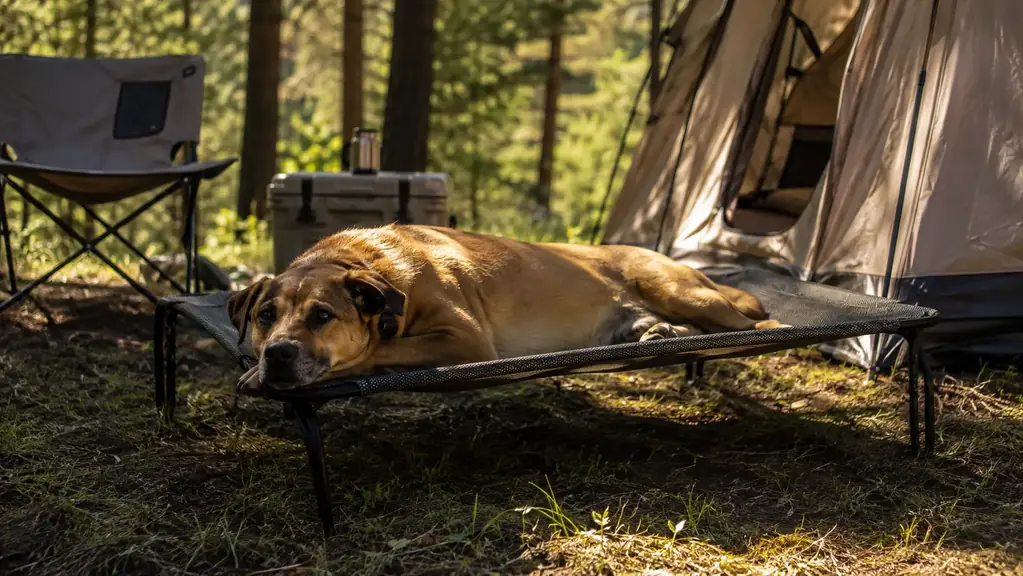
The first time I watched Riggs, my 70-pound camp dog, try to sleep on the bare ground of a tent on a damp September night, I could hear him shift every twenty minutes until past midnight. Every roll pressed him back against cold, wet earth, and by morning he had worked a shallow hollow into the floor and was still not comfortable. A dog that does not sleep is a dog that does not hunt, and a bed that just looks good on the product page is the fastest way to lose a full day of good weather to a restless animal.
I have run through most of the options camping with two dogs over several seasons, and the choice comes down to a handful of real decisions: elevated or flat, mesh or canvas, and the actual fit for your dog. For us the answer most trips is an elevated mesh bed, and the one that has survived two summers at our campsites is the Coolaroo. Here is the checklist I would hand a neighbor before they spend money on an outdoor dog bed that has to hold up to mud, dew, hot sun, and a dog that sleeps like a starfish.
The Elevated Bed We Reach For Every Trip, Frames Down in Minutes
The Coolaroo elevated dog bed keeps dogs off damp ground, breathes in the heat, and folds into a slim carry case that slips under the truck seat. After two summers of camp duty it is the bed I default to. Check today's price before your next trip.
Amazon Check Today's Price on Amazon →Five Checks Before You Buy
No outdoor dog bed is perfect, and pretending otherwise is how you end up hauling a soggy foam pad home from your first campout. These are the five things I check before I hand over money, in the order they matter to a dog that lives on dirt and pine needles.
Step 1: Decide Elevated or Flat Before You Look at Anything Else
This is the fork that decides everything, and it is usually wrong for the people who skip it. A flat pad, even a good one, sits on the ground or tent floor. That sounds fine until overnight dew, a little rain blown under the fly, or a dog that drinks and then flops down. Moisture wicks up through the pad and stays against the dog all night, and a dog that sleeps damp comes up stiff and cranky.
An elevated bed lifts the dog off the ground on a frame, so air moves underneath and the dew and damp never reach them. It dries fast in the sun, keeps ticks and grit out of the sleeping surface, and after a hot day a dog gets the same relief you get sitting in a chair off the ground. The tradeoff is real: elevated beds are heavier, take a couple of minutes to frame up, and are hopeless if you want something to double as a permanent cushion in the house.
Riggs took to an elevated bed almost immediately, and that sold me more than any spec sheet. He spreads out flat, and off the ground he actually stays asleep through the night instead of rolling around every time the earth cools under him. If your dog sleeps in a tent or outside at camp most of the season, my advice is to start by assuming elevated and only talk yourself out of it for a real reason.
Step 2: Size It to the Dog's Sprawl, Not the Box's Breed Range
The sizing rule for a sleeping bed is different from the rule for a crate. A dog does not need to curl up, they need to stretch out, because most good sleepers sprawl into a full-length starfish before midnight. The measurement I use: length from the base of the tail to the tip of the nose with the dog lying flat, then add six to eight inches of margin so a big stretch does not hang a hip off the edge.
Riggs runs about 70 pounds and spreads out to roughly 42 inches flat, and the large Coolaroo gives him just enough room to sprawl without his back end sliding off. The same company makes medium and extra-large as well, and the honest way to pick is to tape out the dog's full length on the floor and compare it against the stated bed dimensions rather than trusting a breed label. Breeds in the same weight class sprawl differently, and a deep-chested sporting dog lying flat needs more length than a square-bodied dog of the same weight.
One more thing before you commit: buy the bed to the biggest of your dogs if they share it, because they will. The smaller dog will happily ride the larger bed, and a bed that fits the big dog always fits the little one. The reverse is a fight you will referee all weekend.
Step 3: Mesh, Not Canvas, For a Bed That Lives Outdoors
Fabric is where a lot of outdoor beds quietly fail. Canvas and heavy cotton feel cozy in the store and make great house beds, but outdoors they soak up dew, hold onto ticks and burrs, and take a long time to dry in the shade. After a wet season the fabric flattens and the bed stops being worth hauling.
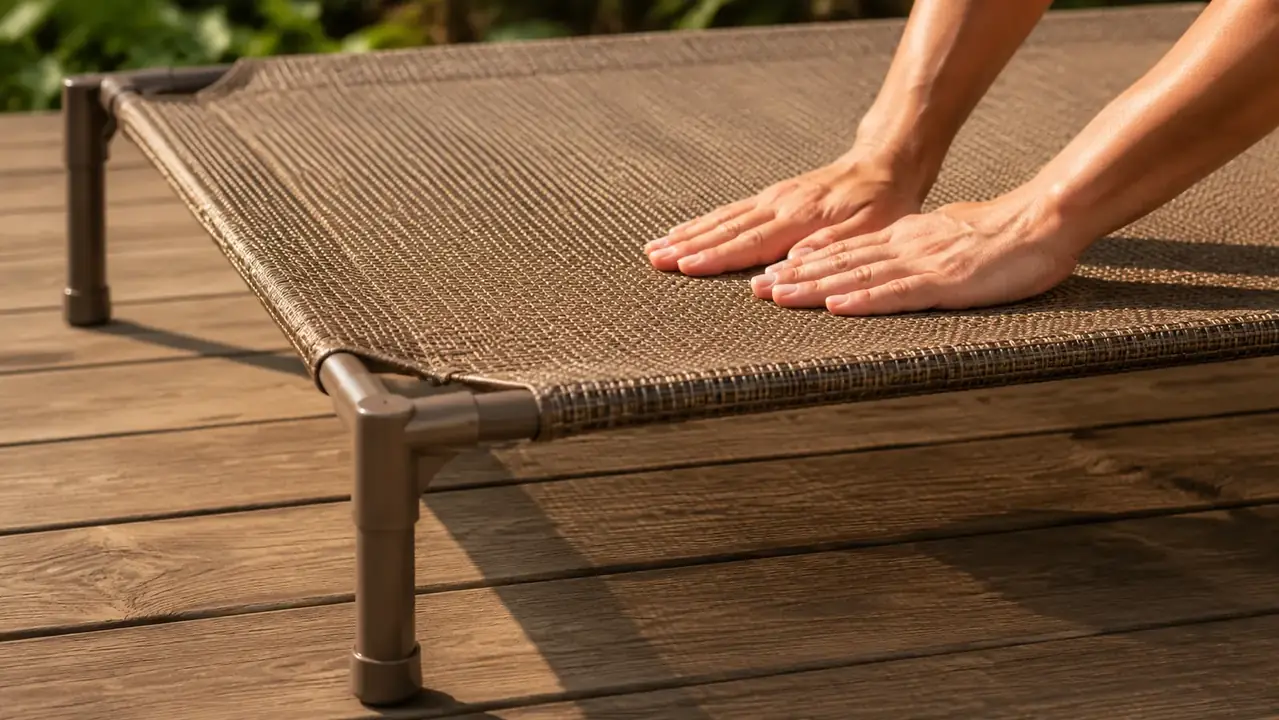
The woven mesh on the Coolaroo is the part that earns its keep. It is breathable, so warm air passes through and the dog stays cooler in the afternoon than they would on fabric, and it does not hold water. Rain rolls off and a wet muddy dog shakes clean, and the surface dries much faster because it is not absorbing anything. Sand and pine needles fall through the gaps instead of embedding in a weave they have to be picked out of.
The mesh does have a tradeoff worth naming: it will sag a little under a 70-pound dog, and it is not a cuddly surface for a dog that wants to be swaddled. Our smaller camp companion prefers a pad on cold nights and eats on the mesh gratefully on warm ones. Match the fabric to the majority of your season, and for dogs that live outdoors in the summer, mesh is the honest choice.
Step 4: Check the Frame, the Fold, and How It Packs in the Rig
An elevated bed is only as good as its frame and legs, because those are the parts that break, and they are the parts you cannot fix at a campsite. What I look for: legs that stand up without wiggling, a frame that does not bow when the dog jumps on the middle, and weld points that are smooth instead of sharp. The mesh should pull taut enough that a dog stepping on the edge does not dump them onto the ground.
Packing is the part new campers forget. A heavy bed is miserable to drag around, and a bed that only folds into a long awkward stick is going to get left home. The Coolaroo breaks into a slim bundle that slips under the truck seat or into a corner of the gear box, and it sets up in a couple of minutes once the legs snap into place. That matters more on the third trip of the season than on the first, so think about storage space before you choose.
Whatever you buy, set it up in the yard before you go. I have watched people reach camp, open the carry case to a pile of parts, and spend the evening sorting tubes in the dark. Ten minutes at home beats thirty frustrated minutes in pine needles.
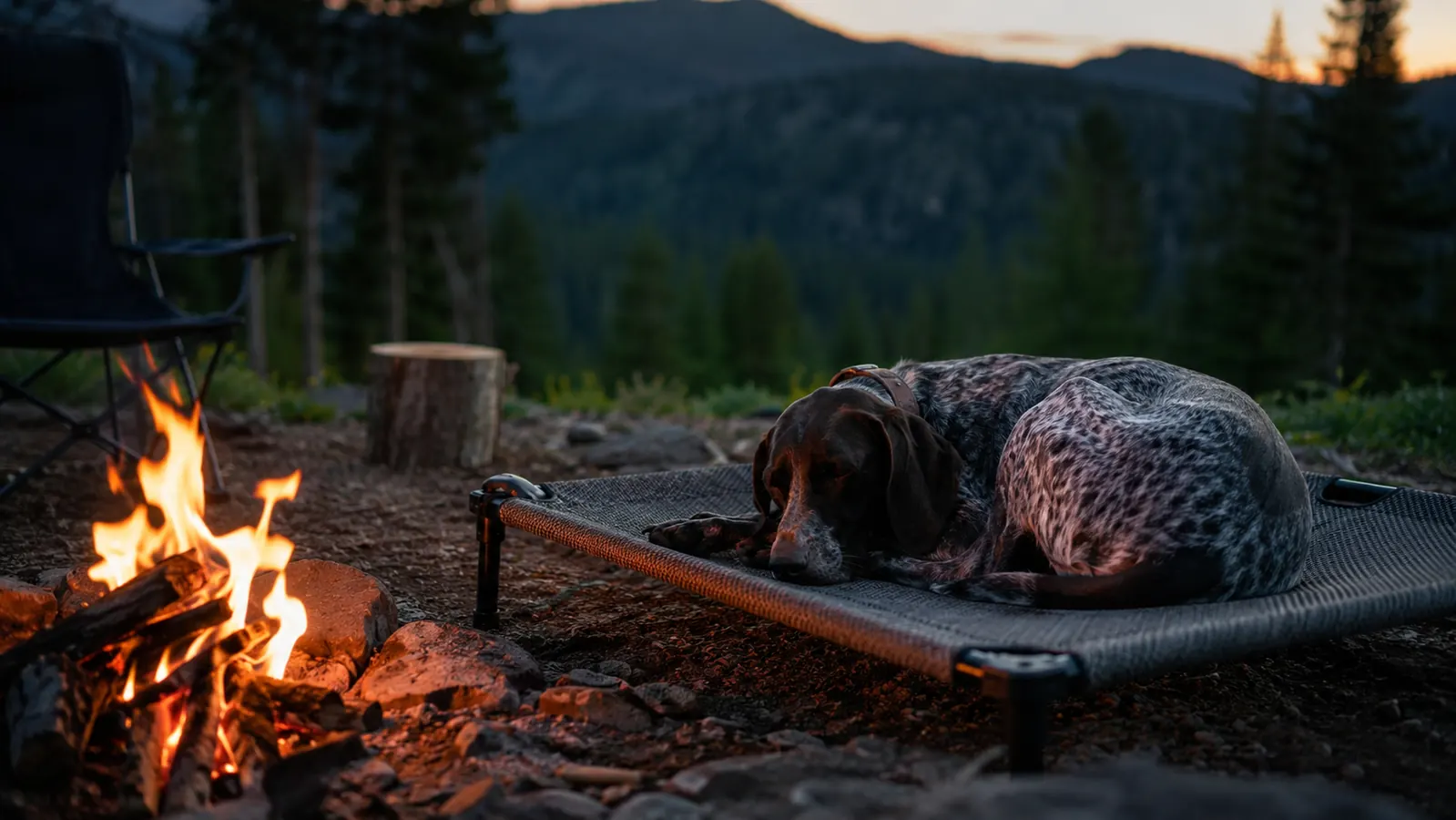
The night that sold me on the elevated bed, we hit a cold snap and the dew was heavy enough to fog my truck windows by midnight. Riggs slept flat on the mesh, dry as a bone and barely stirred. The flat pad next to him came away soaked to the touch.
Step 5: Run a Home Test Before the Trip, and Clean It the Easy Way
The last step is a dry run, and it catches most of the surprises cheaply. Set the bed up on the deck or in the yard for a couple of nights before you leave, let the dogs put a few real sleeps on it, and watch for two things: whether it holds under their weight without sagging into the ground, and whether they actually use it. A dog that circles and walks away from a bed at home will not suddenly love it in the mountains, but a dog that claims it in the yard is a dog that will sleep on it all season.
Maintenance is where an easy bed stays easy. With the mesh, we hose it off in the yard, let it sun dry, and it is ready for the next rig-load. If it has been on tick-heavy ground, a rinse and a shake clears most of what settles in the weave. Set it in the sun the morning after a wet trip and it is dry by midday. A bed you can hose off is a bed that does not turn into a gross chore, and that is worth a lot over a season.
That is the whole checklist: go elevated for ground dwellers, size to the sprawl, pick mesh for the outdoors, trust a solid folding frame, and test it before you haul it. I have watched these five checks turn an overnight mismatch into a bed that has now ridden with us for two summers without complaint.
What Else Helps
Two small things that are not steps but make any outdoor bed last. First, set the bed on slightly higher ground at camp, or at least clear the pine needles and rocks first. A coat of crushed leaves trapped under the mesh packs in moisture and dulls the breathability that is the whole point. Second, put the bed somewhere with some overhead cover on hot afternoons, because even a breathable mesh in full sun is still a dog heating up.
Beyond the bed itself, a ground mat or old wool blanket in the truck gives the dogs a dry spot for rides and roadside coffee stops, which is the other end of a comfortable trip. The two ideas work together, one for traveling and one for sleeping, and together they are most of what a camp dog needs.
None of this is complicated, and almost all of it is just matching the bed to how your dog actually sleeps in the dirt. An elevated mesh bed like the Coolaroo has been the answer for our two dogs, and the checklist above is the reason we no longer haul soggy foam. Get the frame, fabric, and fit right and the bed runs the season for you.
The Bed That Has Hauled With Us Two Seasons Straight
The Coolaroo elevated bed frames down in minutes, packs slim under the seat, and keeps dogs off damp ground all season. If a dog that sleeps like a starfish is wearing out your tent floor, check today's price on Amazon and set it up in the yard before the next trip.
Amazon Check Today's Price on Amazon →