
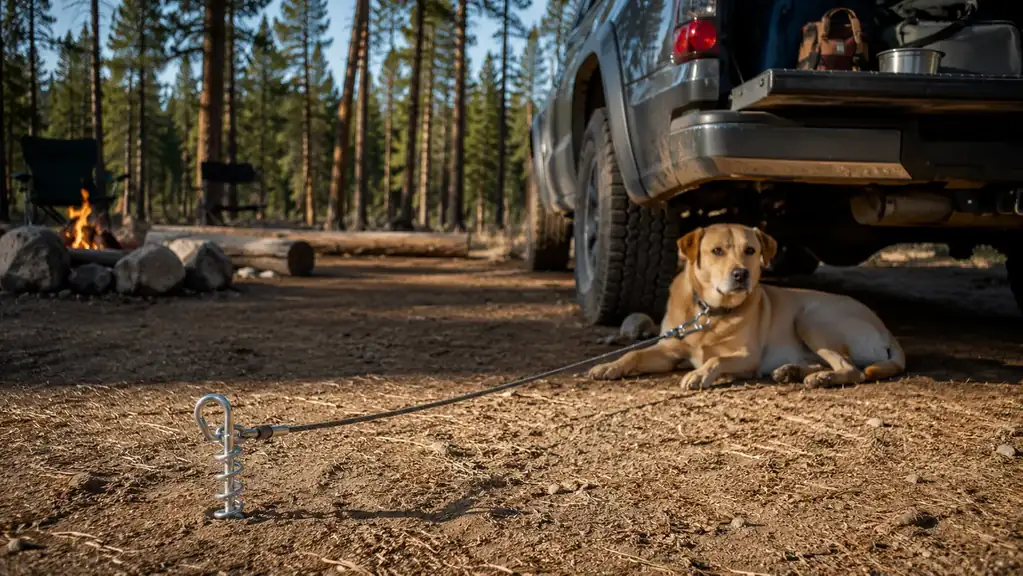
I have tied out a lot of dogs over the years, and I have stood over a sleeping dog at a campsite more than once wondering if the setup behind me was going to hold all night. Here is the thing nobody says out loud. A tie-out is a rope and a metal stake, and both of them are only as good as where you put them and how you watch them. Get the basics right and the Petbobi tie-out I keep in my truck is one of the most useful tools I pack. Get them wrong and you might spend a cold night in the woods chasing a dog that pulled a shallow stake right out of the dirt.
I run a 20-foot cable with a spiral anchor at camp, and a second one in the yard for the days I am working on the truck and cannot have a dog underfoot. This guide is the setup checklist I actually follow, the one that has kept my dogs safe through a full season of campouts. Nothing here is theory, and none of it is complicated. But every step exists because I have seen the bad version of it, the version where somebody drove a stake into soft sand, let the cable out the full length, clipped to a collar, and went back to the fire. I am writing the version I would want handed to me ten years ago.
Start With a Stake That Bites: The Petbobi 16-Inch Spiral Anchor
The whole setup lives or dies on the stake holding. The Petbobi kit pairs a 16-inch spiral ground anchor with a 20-foot cable and a shock spring, built for dogs around my two, the 55-pound hunting dog and the 70-pound camp dog. A kit that costs this little should not have to be this good, but the spring and the no-tangle swivel are the difference between a quiet night and one spent freeing a wrapped cable.
Amazon Check Today's Price on Amazon →Step 1: Pick the Stake Spot Like Your Dog's Life Depends on It
The most common tie-out failure is not a cheap stake, it is a bad spot. I scout the ground before I set anything. I am looking for packed, even dirt and I avoid anything soft like loose sand, fresh fill, or a spot where the topsoil is fluffy. A spiral anchor needs firm material to grip. In a soft patch it will spin and pull free under a hard lunge, and that is exactly when your dog needs it most. The difference between a stake that holds and a stake that does not is often just a few feet of ground, so I do not settle for the first clear patch I see.
I also work out the geometry before I twist the stake in. I want nothing in the radius except open ground. No tree trunks to wrap around, no tent guy lines to trip over, no chair legs to tangle, no fire pit a dog can reach in a running lunge. A 20-foot cable swings a wide circle, so I walk it out mentally and then walk it out for real, checking for anything a dog could snag or a squirrel could bait them toward. That mental walk has a spot in my routine because I got lazy about it once and spent twenty minutes unwrapping a cable from a folding chair.
And I look up. A dog tied out near a low branch will happily play catch with the cable and twine it around the limb. That is a wrap you will untangle at midnight with a headlamp and cold fingers. Give the cable clear sky. Fifteen minutes of scouting has saved me more headaches than any equipment upgrade I have bought. My Petbobi has held through every one of those setups, because the stake was sunk in ground that deserved it and the radius was clear before the dog ever walked into it.
Step 2: Set the Cable Length by the Dog, Not by the Box
I never run my dogs at the full 20 feet unless the site is genuinely open. The idea is to give the dog enough room to be comfortable and do their business, but not so much that they can build up speed and hit the end of the line at a dead run. A dog that gets a good run-up into a taught cable is how whiplash injuries happen, and I have watched it happen to a friend's dog that needed a week to get right again. I shorten the cable to a radius where they can walk, trot, sniff, and settle without sprinting.
How I set it is simple. I clip the cable to the stake swivel, let out the length I want, then tie a small knot in the line or use the included loop so the working length is fixed. The Petbobi cable comes plenty long, and on the tight camp sites I have used maybe half of it. On the open yard days I use more. The length changes with the spot and the dog, and I do not feel bad about it. A shorter, safer radius is not a downgrade. It is a smarter setup, and it is easier on the dog's neck and my own peace of mind.
The shock spring on my Petbobi matters here, that 4-inch coil between the cable and the dog. It absorbs the snap when the dog hits the end of the line. That little spring is the single reason my dogs walk away from a bad lunge without a sore neck, and I would not run a tie-out without one. If you are buying a kit and it has no spring, keep looking. The spring is not optional once you have a dog that likes to chase. It is the difference between a controlled stop and a jolt, and I have seen what a jolt does to a nervous dog.
Step 3: Bury the Stake Deep and Give It a Pull Test
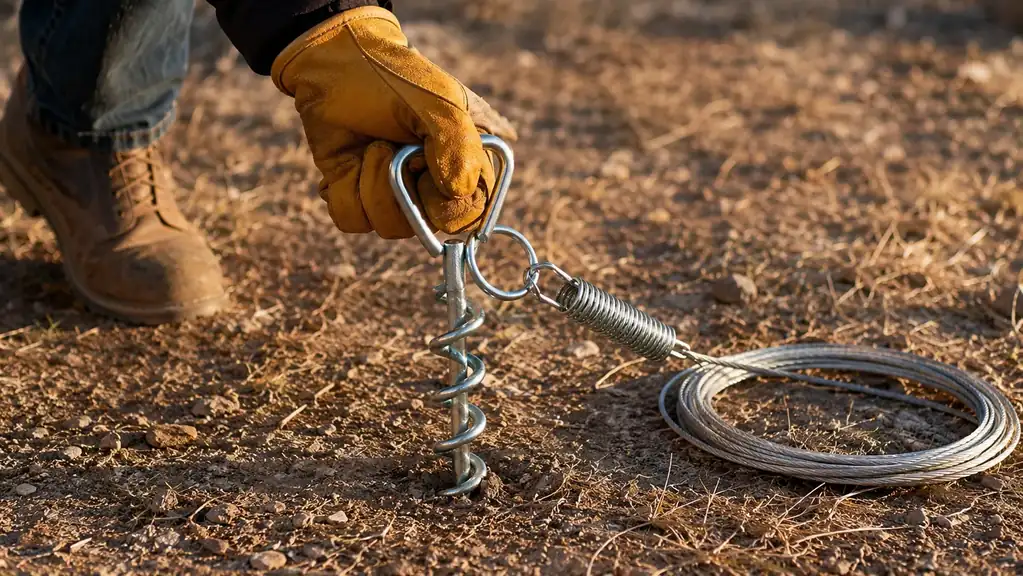
A spiral anchor works like a wood screw in the dirt. You drive it in straight and all the way. I put a boot on the crossbar and turn it down until the top ring is resting right at ground level, not sitting up where a dog could hook a paw or where the leverage is wrong. Too many people sink a spiral a third of the way and call it done. That stake will not survive a squirrel, let alone a 70-pound dog that has decided a raccoon is worth a hard pull. Drive it to the ring.
After I set it, I pull test it. I give the cable a good hard yank at an angle, the way a lunging dog would, and I watch the stake. If it shifts or starts to spin, I set it somewhere else or work it deeper. This takes thirty seconds and it has caught a weak set every single time I remembered to do it. On the softest ground I have even stomped a ring of dirt around the top of the stake to give it a little more bite. That pull test is the cheapest insurance you will do all trip, and it is the one most people skip.
One more thing I do on longer stays: I re-check the stake the next morning. Ground settles, dew softens the topsoil, and a stake that felt solid at 6 PM can feel loose by dawn. Knocking it back down or re-driving it is a two-minute job that does not get skipped in my camp. The Petbobi's 16-inch anchor gives me a lot of hold, but only if it is set the full depth and checked again before the day heats up. That morning re-check caught a loose stake for me twice this season alone.
Step 4: Clip to a Harness, Not to the Collar
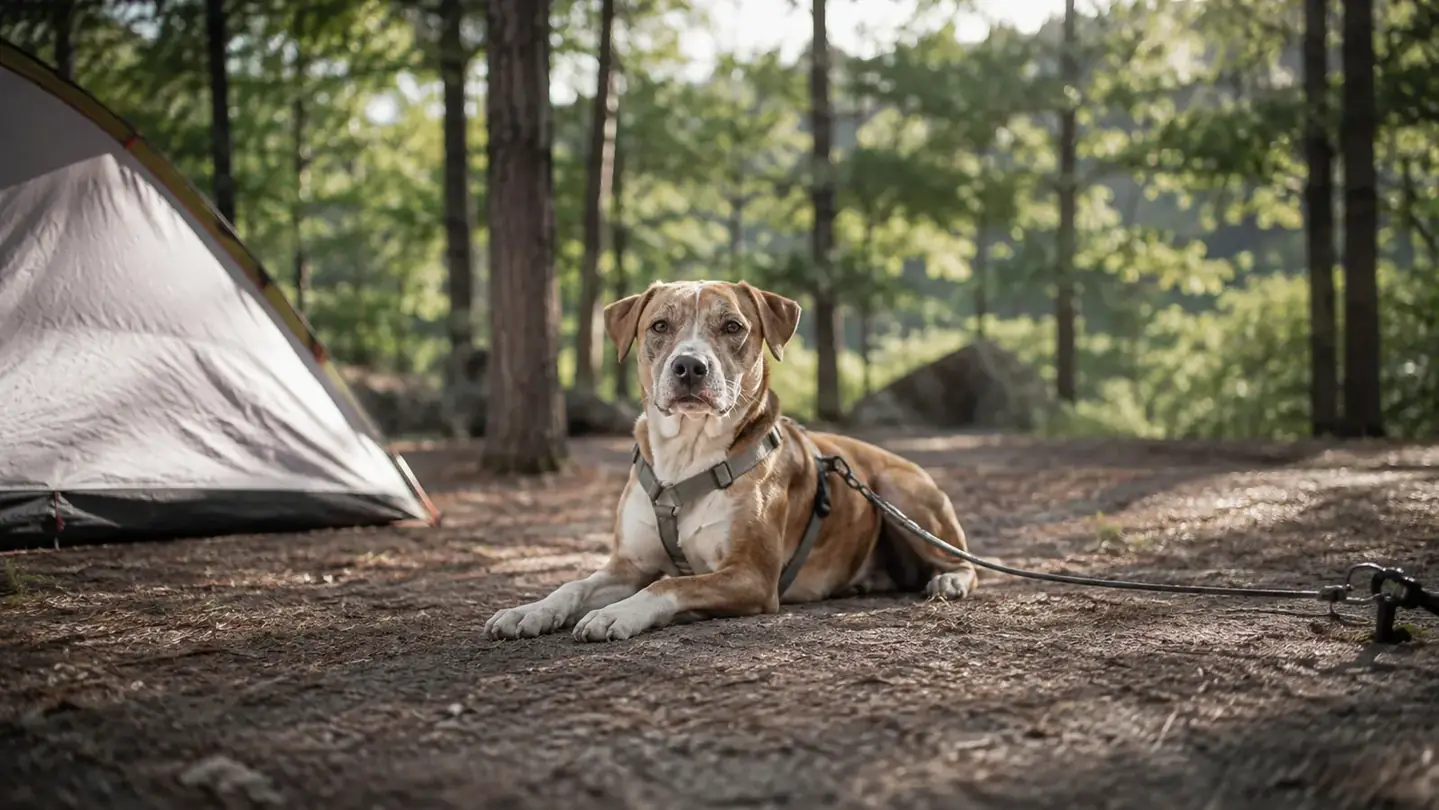
This is the step I will not let anyone talk me out of. I clip the cable to a flat harness, never to a collar. A dog that hits the end of a tie-out at speed with the clip on a collar takes all that force straight to the throat. That is how you get a damaged trachea or a dog that panics and chokes. A harness spreads the load across the chest and back, and it keeps the collar free for tags and a leash hookup. It is a small change and it is the single easiest safety upgrade in the whole setup.
I also keep my own backup rule: I do not leave a tie-out as a long unattended babysitter. A tie-out is for when I am within earshot, working at the tailgate, cooking, or sitting at the fire. It is not a substitute for a fence, and it is not a kennel. If I step away for a while, the dog comes off the line and into the truck or the crate. That is not a judgment on anyone. It is just the honest line I draw with my own two dogs, because a supervised tie-out is a safety tool and an unsupervised one is a gamble.
Step 5: Watch for Tangles, Wraps, and a Snagged Swivel
The no-tangle swivel on the Petbobi handles the constant walking in circles that would knot a plain line, but it is not magic. I still keep an eye on the setup. If a dog walks around the stake in one direction enough times, the swivel does its job and untwists, but if something has jammed the swivel with grit or a burr, the cable starts to wrap and shorten. The first sign is a dog that has quietly lost half their radius. That is my cue to walk over and free things before it gets worse.
I check the swivel a couple of times a day and spin it by hand to make sure it turns free. I wipe dirt and sand off it before I pack it, and I keep the cable coiled in loose loops instead of tight wraps so it does not kink. These are tiny habits, and they are the difference between a tie-out that works for years and one you throw out in a season. Cheap maintenance has kept my Petbobi cable straight and my dogs untangled all summer, and it costs me about ninety seconds a day or less.
A tie-out is only as safe as the ground it is driven into and the eyes you keep on it. Fifteen minutes of scouting and a two-minute morning re-check have kept my dogs safe on more campouts than I can count.
What Else Helps
Water is the thing most people forget. A tied-out dog cannot wander to a puddle, so I set the bowl inside the radius and check it whenever I check the stake. In hot weather that is a lot. I also give a tired dog a good long walk before I tie them out. A dog that has burned energy is far less likely to spend an hour testing the limits of the spring, and a calm tied-out dog is a safe tied-out dog. The tired dog is the best dog, and that is not just a saying, it is how I get a quiet evening out of two working dogs.
Shade matters too. I set the stake so the radius includes some shade by late afternoon, and if the sun swings I move the anchor rather than leave a dog baking. Ground temperature rises fast at camp, and a dog flat on warm dirt in the open gets uncomfortable quickly. A simple tie-out is not a dog run and it is not a fence. Think of it as a convenience for a supervised dog, not a parking spot. That framing changes every setup decision you make, and it is the difference between a dog that settles and a dog that paces the whole radius looking for relief.
The Hardware That Made My Setup Simple: Petbobi 20-Foot Tie-Out Kit
The spring, the no-tangle swivel, and the 16-inch spiral stake are the parts that turned my camp and yard setups into a five-minute chore. If you are tired of tying a leash to a branch and hoping, this is the honest upgrade that makes supervised yard time and camp time safer. Set it up the way I described and it will hold longer than your patience for cleaning fur out of the truck. The setup is the easy part. The hardware just has to show up and hold.
Amazon Check Today's Price on Amazon →